
The call flow builder is an advanced feature best suited for Admins.
In this article, we’ll cover:
Ring users step controls
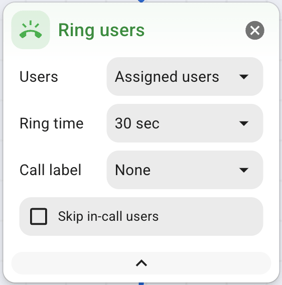
- Users: Lets you select one or more users to receive incoming calls.
- Assigned users: The user(s) assigned to the phone number running the call flow will be rung.
- Users
- Single user: Assign one user to receive the call.
- Multiple users: Ring multiple users at the same time until someone answers.
- User group: Assign a group. See this link for more info.
- Ring time: Provides the option to set the duration of the call before it ends or moves to the next step.
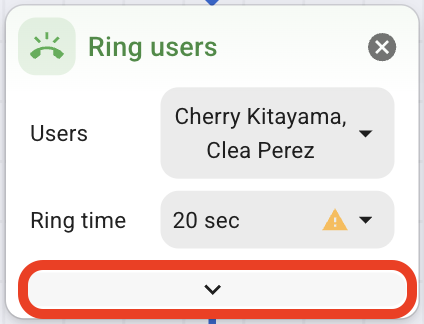
- Advanced options (⌄):
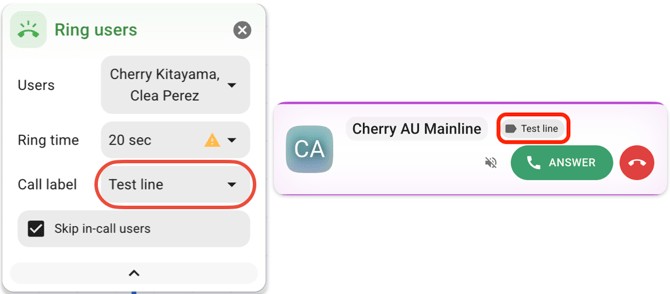
- Call label: Enables the display of a label on the ringing call, allowing users to identify the caller's position within the call flow.
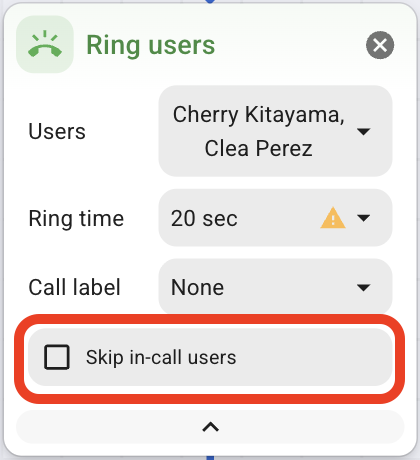
- Skip in-call users: Supports automatically skipping users who are already on a call, routing the call to the following available user or step.
Example call flow
Here's a simple guide on using the ring users step:
-
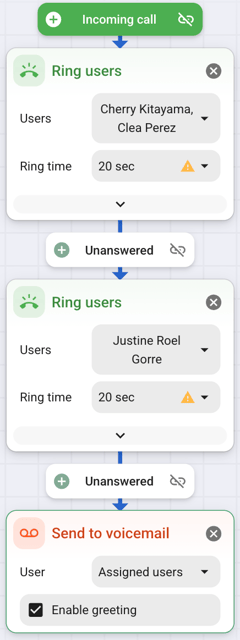
A phone call comes in
 :
:-
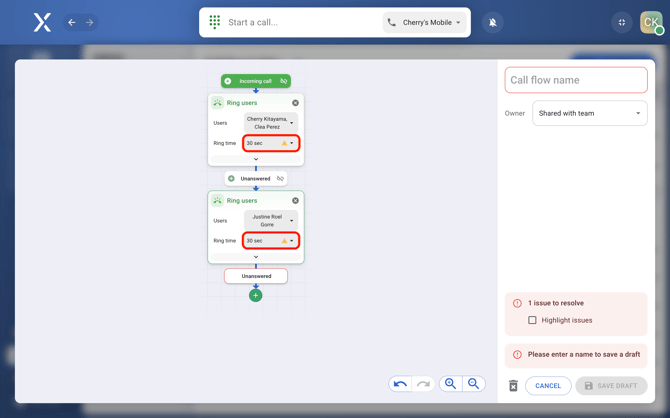
Ring users Cherry and Clea for 20 seconds.
- If no one answers, call redirects to Justine for 20 seconds.
- If still unanswered, the call is sent to voicemail.
-
Guide to create this flow:
- Go to the Admin tab and open the Call flow builder.
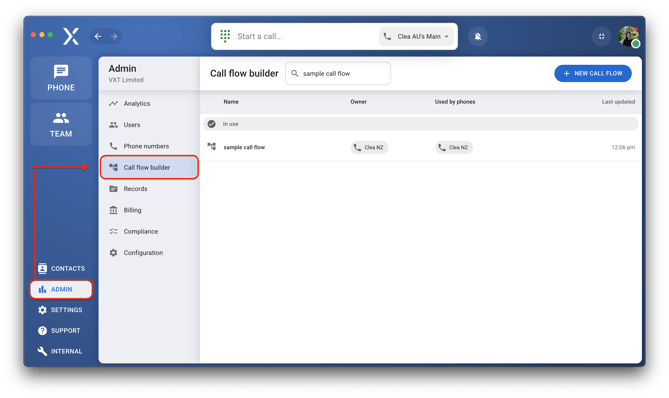
- Create a new call flow or select an existing one you want to edit.
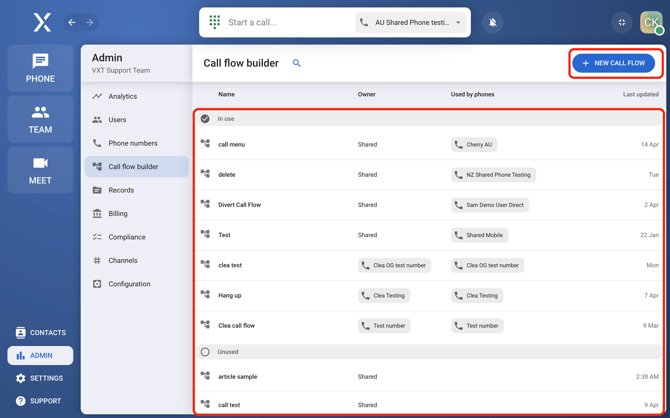
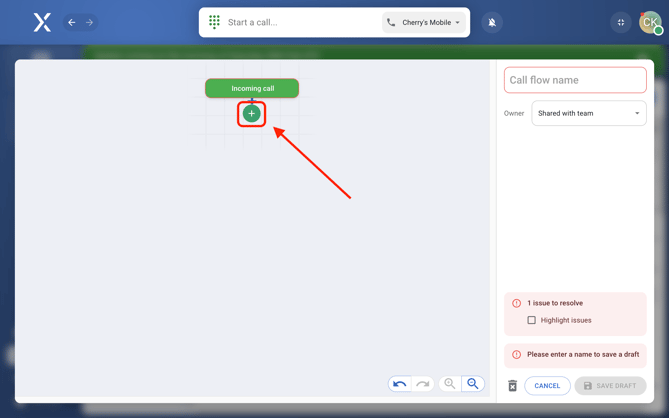
- Once you’ve opened a call flow, click the + icon under Incoming Call.
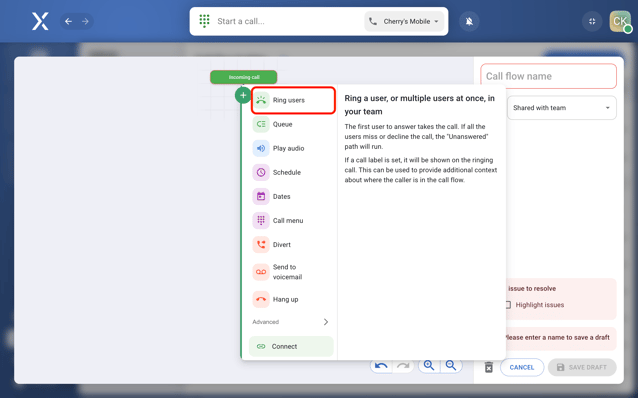
- Select the Ring users step.
- Choose the group or users who should get the call first — here, that’s Cherry and Clea.
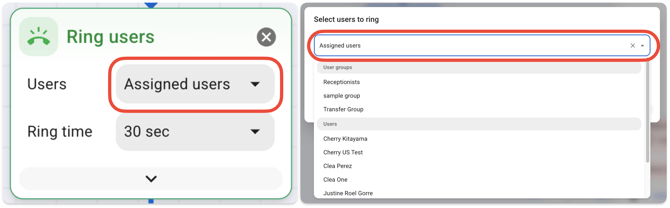
- Choose the group or users who should get the call first — here, that’s Cherry and Clea.
- Click the + icon again to add another Ring Users step.
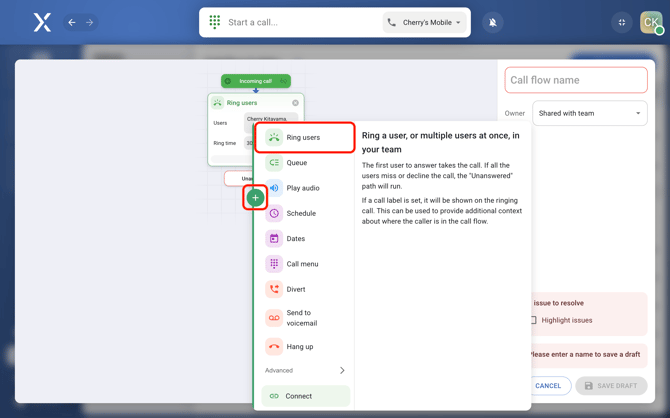
- Select who should get the call next if the first users selected doesn’t answer — in this case, Justine.
- Select who should get the call next if the first users selected doesn’t answer — in this case, Justine.
- Set the call ring time to 20 seconds.
- Optional: Click on the arrow to view more options.
- Enable skip in-call users if you want users to be skipped when they’re already on a call.
- Add a call label, so you'd know which line the calls are coming from.
- Enable skip in-call users if you want users to be skipped when they’re already on a call.
- Optional: Click on the arrow to view more options.
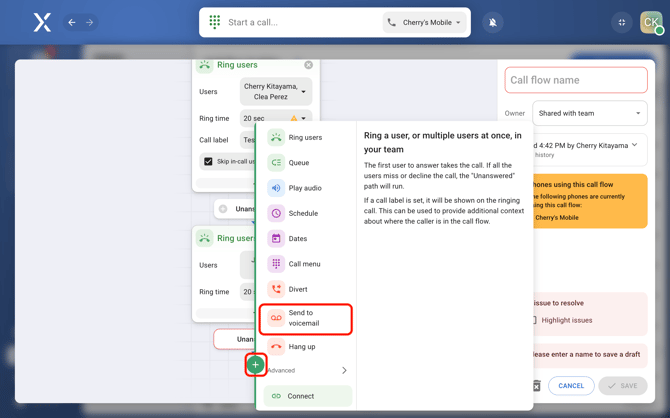
- Click the + icon and select Send to Voicemail.
Common issues to avoid
- We find that customers who have set the ring time to less than 20 seconds often experience a higher number of missed calls, especially on mobile, as their users don’t have enough time to answer before the call ends.
- We’ve also noticed that customers who set the ring time to more than 30 seconds often experience more call drops before someone can pick up, as the caller’s carrier may hang up automatically if the ringing continues for too long.
- When there are too many ring actions, which makes the ring time too long, the changes of drop calls also increase. You can avoid it by adding a play-audio at the start of the call flow.